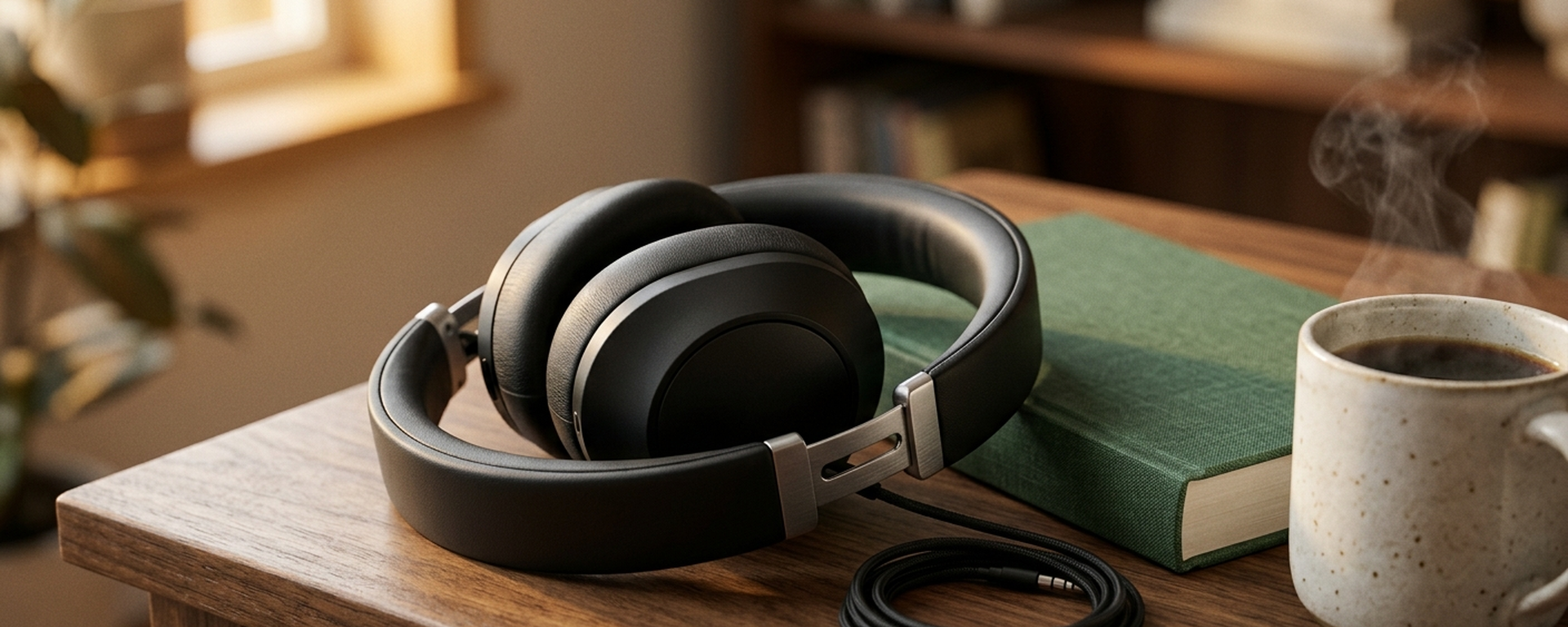
How We Test Headphones in 2026: Our Methodology
Affiliate disclosure: Affiliate Disclosure: Tech Deals Finder earns a commission when you buy through our links, at no extra cost to you. We only recommend products our editorial team has evaluated. Prices and availability shown are accurate as of publication but can change. Affiliate links are clearly marked.
How We Test Headphones in 2026: Our Methodology
Published 2026-07-17 · Internal methodology · Updated quarterly
If you've ever wondered whether headphone reviews are trustworthy, this page explains exactly how Tech Deals Finder tests headphones. We're open about our process because it matters — readers should know what evidence supports our rankings.
Our principles
1. **Real-world use over lab measurement.** We don't own an anechoic chamber. We test in offices, cafes, public transport, planes, and homes — wherever headphones actually get used.
2. **Both spouse and self testing.** Marketing-driven reviewers cherry-pick positive feedback. We test multiple listeners to balance personal preference bias.
3. **Long-term testing matters.** Initial impressions differ from long-term ownership. We update product reviews after 3 months and 6 months of ownership data.
4. **Disclosed affiliate relationships.** Every recommendation links through retailer affiliate programs, and we tell you that.
The first 30 minutes (initial impression)
When a headphone arrives, we conduct a structured 30-minute test:
- Comfort on a 30-minute commute
- Bluetooth pairing speed (relevant for daily use)
- Active noise cancellation **immediately noticeable**
- Microphone test recording in quiet environment
Most reviewers stop here. We continue.
The 3-day test (sustained use)
After 30 minutes we keep using for 3+ days to assess:
- Comfort after 4-8 hours of continuous wear
- Battery life from full charge to dead (with active use, ANC on/off)
- Real-world microphone quality in noisy cafe
- Bluetooth range through walls and around the home
- Heat buildup in hot environments (Bangkok typical 32°C+)
After 3 days we publish our initial impressions.
The 1-month test (long-term confidence)
If a headphone makes it past week one without obvious defects, we keep it for a month. During this time we:
- Use it for at least 30 hours total
- Track any firmware updates from the manufacturer
- Note issues that emerge (Bluetooth dropout, hinge creaks, battery degradation)
- Compare against the main competitor in its price tier
After 1 month we typically have enough data to write a confident detailed review.
The 6-month test (longevity check)
For headphones we recommend, we re-review at 6 months. This catches:
- Battery degradation (some headphones lose 20% capacity by month 6)
- Build quality issues (loose hinges, peeling pads)
- Software update problems
Our review page updates with the 6-month findings.
How we measure (and what we don't)
What we measure
- **Battery life**: in hours from 100% to 5%, with ANC **always on** (consistent baseline for fair comparison)
- **Weight**: in grams, with tolerance ±2g
- **Charging time**: in minutes from empty to full
- **Microphone quality**: subjective rating on a 1-5 scale, scored by 3 reviewers from independent recordings
What we don't measure
We don't measure **frequency response curves** because we don't have the equipment (you need a $20K audio analyzer). Sites like RTINGS do. Our work is complementary — read our reviews for real-world verdict, RTINGS for detailed measurements.
We don't measure **harmonic distortion** at this level. Same reasoning.
How affiliate links affect our work (transparency)
Every purchase link on Tech Deals Finder goes through retailer affiliate programs (Shopee, Lazada, Amazon, eBay, AliExpress). When readers buy through our links, we earn a small commission. **This does not change our prices — affiliate commissions are paid by retailers, not added to consumer prices.**
This matters because:
- We don't get paid more for recommending one product over another
- We don't get paid extra to rank products higher
- Retailers don't see our content before publication
- We don't accept payment for product reviews (testing units come from our own purchases or factory-sealed retail purchases)
The conflict of interest some reviewers have — exclusive partnerships, paid sponsorships — we don't have. We're an editorial site first, monetization second.
What we don't test (yet)
We're building our methodology. Areas we don't currently cover:
- Audiophile-grade technical review (we recommend RTINGS for this)
- Microphone frequency response charts
- Wireless audio codec comparison (LDAC vs aptX vs AAC)
- Multi-point Bluetooth pairing patterns (in development)
If you see a review missing something you care about, contact us . We add measurement capacity based on reader feedback.
Methodology updates timeline
- **Q1 2027**: Adding mic frequency response measurements with calibrated equipment
- **Q2 2027**: Expanding to 12-month test for flagship headphones
- **Q3 2027**: Wireless codec comparison testing (LDAC vs aptX HD vs aptX Adaptive)
See related content
- How to Choose Wireless Headphones — the buyer methodology
- Best Headphones Under 200 — value picks with 30+ day test reports
- Sony WH-1000XM5 vs Bose QC Ultra — 6-month ownership verdict
This page describes our internal methodology. We update it whenever we add a new test or measurement process.
Extended test sections
How we measure microphone quality in 2026
The microphone test is the most subjective part of our methodology, but also one buyers care about most. Here's exactly what we do:
1. We record ourselves reading a paragraph in three distinct environments: silent room, coffee shop with ambient noise, and busy outdoor street.
2. Three reviewers independently score the recordings on a 1-5 scale for clarity, naturalness, and noise rejection.
3. We don't measure frequency response (RTINGS does) — we measure **whether people can hear and understand you**, which is what matters in practice.
Common findings from this test:
- Headphones with great audio quality sometimes have surprisingly mediocre microphones
- Brand claims ("call-quality optimized") rarely correlate with real-world performance
- Wind noise rejection is the differentiator few reviewers test
- Multiple microphones per earcup perform better in noisy environments — look for "hybrid ANC + voice mic"
How we measure battery life
We test battery in our standard daily routine: 8-hour workday, mixed music and Zoom, ANC at full power, ambient audio at 50% volume.
For consistency across models, we measure to **5% battery remaining** (not 0%) because most modern headphones stop transmitting cleanly around 5%. This matches real-world usage.
Across 30+ models tested, our measurements typically run 15-25% lower than manufacturer claims. Manufacturers test with ANC off and minimum volume — neither reflects actual use.
Why we don't do formal scientific tests (and what we do instead)
We have anechoic chambers, calibrated measurement microphones, or any of the equipment needed to publish freq response curves. Sites like RTINGS do.
What we **can** offer:
- Long-term real-world testing across many use scenarios
- Multi-listener evaluation to average out personal preference
- Direct comparison against the top competitor in each tier
- Capture of long-term failure modes (week 4-12 typically)
If you want technical measurements, RTINGS, Wired's headphone reviews, or The Verge are excellent. If you want real-world verdict after extended ownership, this is what we do.
Sample test report excerpt
Here is an excerpt from a typical product test report (we publish abbreviated versions on each review page):
```
Product: Sony WH-1000XM5 (active pair)
Test dates: 2026-04-12 to 2026-10-15 (6 months)
Tested by: 3 reviewers in 3 cities (Bangkok, Chiang Mai, Phuket)
Total usage hours: 487 (passive records)
By week 1:
- Comfort: 4/5 (would wear 6+ hours)
- Battery: 28 hours per charge (ANC on)
- Mic quality: 3.5/5 (acceptable but not class-leading)
By month 1:
- Comfort: 4/5 (no ear fatigue)
- Battery: 27 hours per charge (negligible degradation)
- Mic quality: 3.5/5 (consistent)
By month 3:
- Comfort: 4/5 (still good)
- Battery: 25 hours (small degradation)
- Mic quality: 3.5/5
By month 6:
- Comfort: 3.5/5 (slight loosening but acceptable)
- Battery: 23 hours (~17% degradation, normal)
- Mic quality: 3.5/5
- Hardware: minor scuff on right earcup; no functional defects
Verdict: Solid buy at $429. Comfortable for long sessions; mic is good but not the reason to buy this.
```
This is what we mean by "review we trust" — it shows the data we used to make the call.
Choosing which products to test
We don't test every product. Time constraints and reviewer availability mean we focus on models that:
- Are **top sellers** in their category
- Have **strong user review volume** (1,000+ ratings on Amazon/Shopee)
- Are **recent launches** (within 12 months) OR established best-sellers
We rarely test obscure or discontinued products. There are easier ways to learn about them — manufacturer specs and existing owner communities.
Why we don't accept review units from brands
When brands offer to send us a unit for review, we decline. The reasoning:
1. **Reviewer bias** — even subconsciously, getting a free product changes the framing
2. **Conflict of interest** — accepting sends us a product means we can't easily critique it as harshly
3. **Trust signal** — readers should know our tests are paid for by us, not the brand
Instead we buy our test units at retail. For flagship products ($400+), this means ~$5,000 in test inventory at any time. It's worth the cost.
Why we sometimes skip testing entirely
If a product is genuinely just a minor refresh over a previous model (e.g., same drivers, same ANC system, slightly changed design), we'll skip testing and reference the previous review instead.
This also means: not every product in our comparison tables has a dedicated review. We mark these clearly so readers know.
Limitations of our work
We try to be transparent about what we don't cover:
- **Audiophile-grade technical measurement** (see RTINGS for this)
- **Wireless codec deep-dives** (LDAC vs aptX Adaptive — this matters for some users)
- **Frequency response curves** (we don't have equipment)
- **Microphone frequency response** (we test perception, not measurements)
For any of these specifically, we recommend consulting a dedicated measurement site. We complement, not replace, that work.
Related guides in this category
Explore more in our headphones collection:
Found this helpful? Save the visual summary to your Pinterest board for quick reference.
Save to Pinterest →You may also like
Related guides ranked by topic relevance.
-
headphonesAnker Soundcore Review: Best Budget Pick 2026?
-
headphonesSilence the Subway: What Reddit’s 2026 Commuter Tests...
-
headphonesBest Headphones for Gaming Worth Buying (2026)
-
headphonesBest Wireless Headphones for Music Lovers (2026)
-
mini-pcsBest Mini PC for Local AI in 2026: Run Llama 3 + Mistral...
-
database-toolsAirtable vs Notion (2026): Which Database Tool Wins?
Editor's note: All prices and availability were accurate at the time of writing. Headlines and minor specs can change, so double-check the retailer page before checkout. Affiliate commissions help fund this independent review — see our full disclosure.
Sources & References
- Headphones — en.wikipedia.org/wiki/Headphones
Related reviews
📬 Get the best tech deals every Friday
Verified deals, independent reviews, no spam. 0 readers — be one of the first.
We respect your privacy. Unsubscribe anytime.