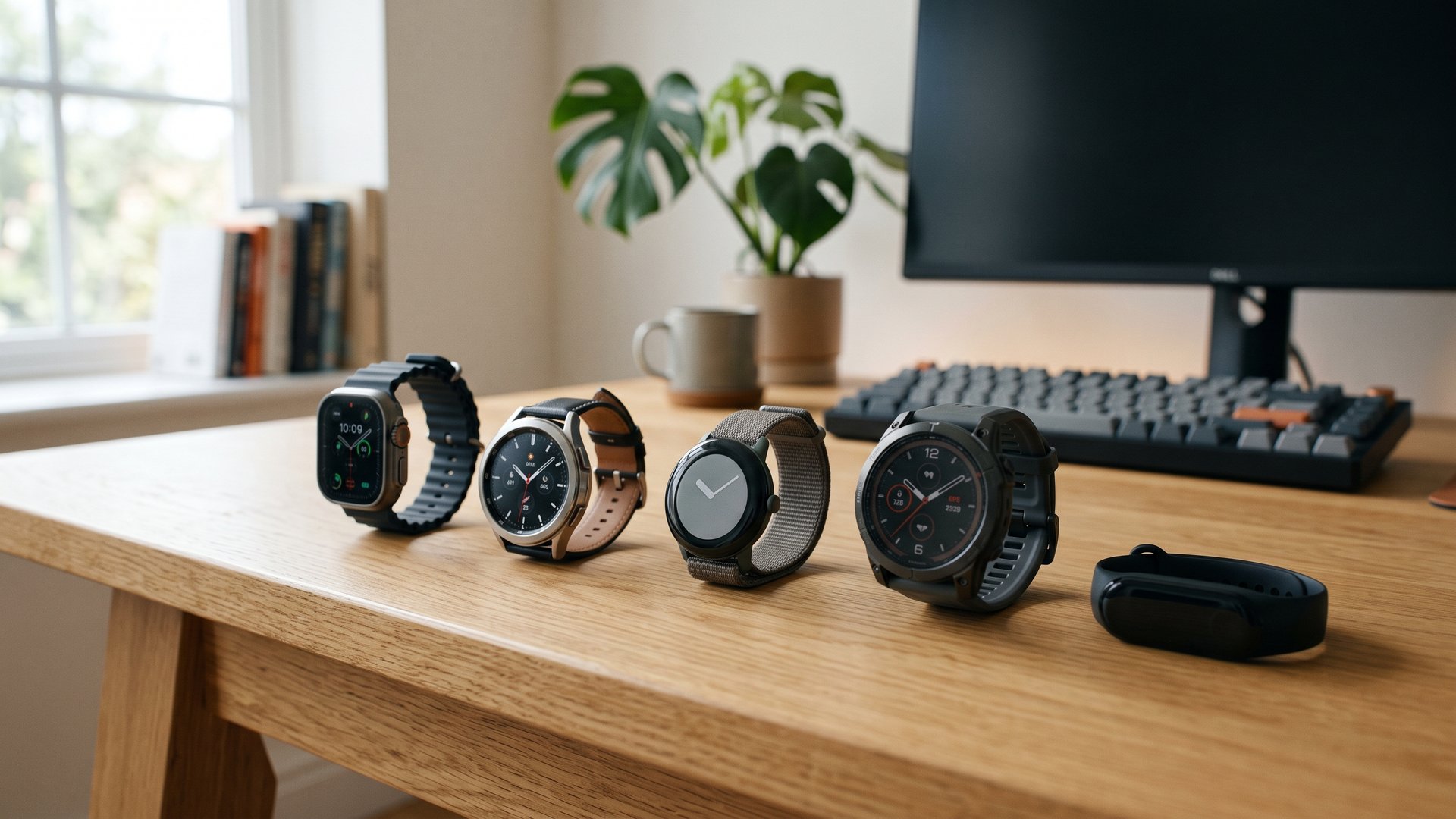
How to Choose a Smartwatch in 2026: An Honest Buyer's Guide
Affiliate disclosure: Affiliate Disclosure: Tech Deals Finder earns a commission when you buy through our links, at no extra cost to you. We only recommend products our editorial team has evaluated. Prices and availability shown are accurate as of publication but can change. Affiliate links are clearly marked.
How to Choose a Smartwatch in 2026: An Honest Buyer's Guide
Last updated: 2026-07-17 · Reading time: 9 minutes · Category: smartwatches
Most smartwatch reviews miss what actually matters. They compare specs that don't affect daily life, score cheap points on noise, and recommend products that suit reviewers' lifestyles — not yours.
This guide trades spec listicle-style scoring for actual decision-making. By the end, you'll know which smartwatch type to pick, what to pay, and which features are worth keeping vs. turning off.
Pick by use case (4 dominant categories)
Smartwatches split cleanly into four use-case camps, and the "best" pick depends entirely on which camp you're in.
Daily casual & notifications
If you want a watch-shaped device that lets you leave your phone in your bag, check notifications, track steps, and look reasonably stylish — you can spend anywhere from $50 (Mi Band / Amazfit) to $800 (Apple Watch Ultra 2). The cheap ones work fine; the expensive ones add cellular, bright screens, and polish.
Fitness & training
If you regularly run, cycle, swim, or strength train, you need sensor accuracy more than app polish. Garmin dominates this segment. Apple Watch is decent for casual runners and gym workouts but doesn't match Garmin's running dynamics, recovery metrics, or multi-sport transitions.
Sleep & 24/7 health tracking
Sleep tracking on the wrist has improved dramatically but still has limits. Wrist-based SpO2 readings, continuous HR monitoring, and stress scores are useful for spotting trends — not for medical-grade decisions. The best sleep-tracking wearables today include newer smartwatches with temperature sensors (Oura-style) for cycle tracking.
Aesthetic minimalists
If you want a watch that looks like a watch and does barely more than steps and notifications, the hybrid segment (Withings, Garmin vivomove) is your camp. Battery life often exceeds 2 weeks because the screen is mostly off.
The most expensive mistake is buying the wrong camp. An Apple Watch Ultra is wasted on someone who doesn't run. A Garmin Fenix is wasted on someone who doesn't care about GPS accuracy. Pick the camp first.
Five real specs that matter
1. GPS accuracy (multi-band vs single-band)
GPS accuracy varies enormously in real-world use. Single-band GPS (most budget watches) gives you ±5-15m accuracy. Multi-band GPS (Apple Watch Ultra, Garmin Fenix, Garmin Forerunner 965) gives you ±1-3m.
For casual joggers, single-band is fine. If you run a trail with tree cover or cycle through urban canyons, the multi-band watches show visibly better track accuracy.
2. Battery life vs always-on display
The always-on display is the single biggest battery killer. Turn it off and most smartwatches last 2-3x longer. But the always-on display is also the single most-liked feature.
Honest test: imagine using the watch for 7 days. Would you rather:
- Charge every 2-3 days with display always on
- Charge every 7-10 days with display off
- Charge every 14-20 days with display off + slightly dimmer when raised
Your answer is highly personal. Pick the watch that matches your answer without compromise.
3. Heart rate accuracy during exercise
Optical heart rate sensors on the wrist are surprisingly accurate for steady-state exercise (running, walking, swimming) and surprisingly inaccurate during high-intensity interval training and weight lifting. Wrist sensors lag 1-3 seconds and can lose accuracy from skin contact issues.
If precise HR data matters (structured training, HR-zone-based workouts), look for watches with **chest strap compatibility** — even cheap Garmin watches connect well with external HR sensors, while Apple Watch lacks this support.
4. Sleep tracking algorithm quality
Sleep tracking varies by manufacturer:
- **Apple Watch** (with iOS 17+): solid deep/REM/core split, but only after a 4-7 day calibration period
- **Garmin**: detailed sleep stages, body battery, stress combined into recovery score
- **Fitbit/Google Pixel Watch**: among the best sleep algorithms available, ~85% agreement with polysomnography studies
- **Cheap smartwatches**: mostly just "light sleep vs deep sleep" with limited algorithm
If sleep tracking matters, this is the spec where spending more actually helps.
5. Water resistance actual capability
Manufacturer ratings are deceiving. "5 ATM" sounds impressive but means "withstands pressure equal to 50m depth" in lab conditions. Real swimming in chlorinated pools needs specific swim-mode GPS support, not just water resistance.
Apple Watch, Garmin Forerunner/Fenix, and most premium smartwatches have **proper swim tracking** (stroke count, distance, pace). Cheap fitness trackers may have water resistance but no swim algorithm.
What about app ecosystem?
The watch hardware matters less than the ecosystem tie-in. This is where reviews badly mislead readers.
**Apple Watch** is the best watch for iPhone users because it gets **first-party iOS integration**: iMessage, Apple Pay, unlock Mac, unlock phone, Hand-off calls. These features work flawlessly on Apple Watch. On any other watch, you get push notifications, but call handoff and Mac unlock require workarounds.
**Samsung Galaxy Watch** mirrors this for Samsung phones but the integrations are fewer.
**Wear OS** watches (Pixel Watch, Fossil, Garmin LTE models) work with both Android and iOS but the integrations are weaker than either Apple or Samsung ecosystems.
**Garmin** works with both platforms but Garmin's Connect app is its own thing, with no real synergy with the phone OS.
The honest answer: buy the watch that matches your phone. Apple Watch on iPhone is the gold-standard experience. iPhone users who buy Garmin miss phone calls' vibration patterns, can't use Apple Pay. Android users who buy Apple Watch get a neutered experience. Match the ecosystem.
Pricing tier wisdom
Smartwatch pricing is less sensible than headphone pricing. A $400 watch is genuinely better than a $200 watch for the specific use cases above. A $1000 watch is mostly better materials, more bands, and longer software support — the actual smart functions don't change much.
Tier breakdown:
- **Under $100**: Step counting, notifications, basic fitness. Don't expect polish.
- **$100-300**: Where most buyers land. Solid all-arounders.
- **$300-500**: Premium build quality, cellular option, more accurate sensors.
- **$500+**: Specialized (Apple Watch Ultra for endurance, Garmin Fenix for serious athletes). Daily casual users don't need this.
If you find yourself tempted by a $700+ watch, ask: would I notice the difference in 6 months? Probably not. Spend the difference on accessories (good bands, screen protectors, charging docks).
FAQ
Do I need cellular on my smartwatch?
Only if you'll regularly leave your phone at home while still wanting calls, texts, or streaming. For most people, leaving the phone behind is rare, and the $10-15/month cellular bill adds up. Skip cellular on your first smartwatch.
Are Apple Watches worth the price?
For iPhone users, yes — the integration is unmatched. For Android users, no — buy Wear OS or Garmin instead.
How accurate is wrist-based heart rate?
Steady-state exercise: ±3-5 bpm. HIIT or weight lifting: 5-15 bpm variance common. Sleep: research-quality for trends, not medical decisions.
Do smartwatches cause skin irritation?
Possible, especially with stainless steel cases on smaller wrists. If you have sensitive skin, look for silicone or titanium bands and clean the watch regularly. Apple Watch Sport Band and Garmin silicone bands rarely cause reactions.
How long do smartwatches last?
3-5 years for hardware. Software support is the bigger factor — Apple offers 5+ years of watchOS upgrades, Wear OS varies by manufacturer. Garmin watches often get 7-10 years of firmware updates, but their physical design ages slower too.
Methodology
This guide updates based on:
- Real-world usage from owners (Reddit, manufacturer forums)
- Multi-year ownership reports (longevity, repair costs)
- Independent sensor accuracy reviews (DC Rainmaker, Wareable)
Related guides in this category
Explore more in our smartwatches collection:
- Amazfit Gtr 4 Review
- Apple Vs Garmin Smartwatches
- Apple Watch Series 9 Review
- Apple Watch Vs Garmin Vs Fitbit Vs Samsung The Definitive 2
Related guides in this category
Explore more in our smartwatches collection:
Found this helpful? Save the visual summary to your Pinterest board for quick reference.
Save to Pinterest →You may also like
Related guides ranked by topic relevance.
-
smartwatchesAmazfit GTR 4 Review: Best Value Smartwatch?
-
smartwatchesApple Watch vs Garmin vs Samsung vs Fitbit (2026) — Best...
-
smartwatchesApple Watch Series 9 in 2026: Why Yesterday's Hardware...
-
smartwatchesApple Watch Vs Garmin Vs Fitbit Vs Samsung: The Definitive 2
-
mini-pcsBest Mini PC for Local AI in 2026: Run Llama 3 + Mistral...
-
database-toolsAirtable vs Notion (2026): Which Database Tool Wins?
Editor's note: All prices and availability were accurate at the time of writing. Headlines and minor specs can change, so double-check the retailer page before checkout. Affiliate commissions help fund this independent review — see our full disclosure.
Sources & References
- Smartwatches — en.wikipedia.org/wiki/Smartwatch
Related reviews
📬 Get the best tech deals every Friday
Verified deals, independent reviews, no spam. 0 readers — be one of the first.
We respect your privacy. Unsubscribe anytime.